Calving ease sits at the heart of profitable suckler and beef enterprises, yet it is still too often taken for granted. In this article, General Manager, Seth Wareing explores the drivers of calving difficulty and how Hereford genetics can help reduce costs and safeguard cow and calf welfare.
The 2:00 AM Dread practical realities of night‑time calving
Every beef producer knows the weight of the calving season. It’s the period defined by the 2:00 AM trudge to the calving pen, the cold evening air, and that nagging knot in your gut when you see a heifer that has been straining for too long. At the centre of this stress is dystocia, the clinical term for a difficult birth.
I look at the blueprint of a lot of commercial herds, and right now, for many producers, the blueprint is broken. We’ve come to accept the exhaustion and the vet bills as “part of the job,” but the numbers tell a story that most of us don’t want to hear: much of this seasonal dread is a self inflicted wound. By challenging our instincts to intervene and shifting our genetic focus, specifically toward the proven efficiency of Hereford genetics, we can stop the bleeding. It’s time to move from crisis management to a season where “low-maintenance” isn’t just a buzzword, but a reality.
The help paradox: why reduced intervention can improve calf survival
There is a powerful instinct to help when we see a cow in labour. However, we often mistake the cow’s need for time with a need for force. A major study by the University of Edinburgh found a dystocia prevalence of 17.8% across British beef farms.
Data on calf survival from the US Meat Animal Research Center (MARC) highlights a clear contrast:
- Unassisted births: average calf loss within 24 hours is approximately 4 per cent.
- Assisted births: average calf loss increases to approximately 16 per cent.
When we do intervene, we often bring a calving jack mindset to a biological problem. A human can safely apply about 100kg of force, roughly what two strong men can pull. A calving jack, however, can apply up to 400kg. That is a 4:1 ratio of mechanical force over human safety limits. Applying that much power leads to broken ribs, internal trauma, and lethargic calves struggling with acidosis. Many cows simply need more time for natural dilation rather than a mechanical pull.
The Hidden Fertility Debt: Dystocia’s Long-Term Impact
The true cost of a difficult birth isn’t just the calf you might lose today; it’s the cow you’ll lose tomorrow. Dystocia is a silent villain that creates a massive fertility debt. While you’re focused on the health of the newborn, the dam is struggling with a delayed return to cycling, or postpartum anoestrus.
Research from MARC highlights the quantifiable reproductive toll on cows that required assistance:
- 14% lower detection in oestrus during the subsequent 45 day AI period.
- 16% lower pregnancy rate at the end of the breeding season (69% for assisted cows vs. 85% for those that calved unassisted).
If a cow misses one or two cycles because she’s still recovering from a hard pull, she’s either calving late next year or, more likely, leaving the herd as an expensive open cow. These are the hidden costs that eat your profit margin from the inside out.
Body condition and calving difficulty
Producers often fear fat cows (BCS > 4.0) because they worry internal fat will block the pelvic canal. While obesity is a risk, the University of Edinburgh study identified a much more prevalent danger: the under-conditioned dam.
The data showed that thin cows (Body Condition Score < 2.5) had a significantly higher assistance rate:
- Thin cows (BCS < 2.5): 27 per cent assistance rate
- Ideal condition (BCS 2.5–3.5): 17 per cent assistance rate
A thin cow lacks the energy reserves for the intense muscular work of labour. This leads to Secondary Uterine Inertia, where the myometrium (uterine muscle) simply becomes fatigued and stops contracting before the job is done. It isn’t just about fuel; it’s about physiological failure. Ensuring your dams hit a BCS of at least 2.5 ensures they have the metabolic strength to finish the delivery on their own.
Genetics and calving ease: the Hereford advantage
While management and nutrition handle the current season, genetics are the blueprint for the next five years. To solve the problem of a big calf, which accounts for 50% of dystocia cases, we have to choose sires that fit the dam.
The MARC data shows a massive gap between the Hereford blueprint and the Continental breeds often selected for heavy muscling and foetal hypertrophy (excessive foetal growth):
- Hereford‑sired calves: 2.9 per cent assistance rate
- Charolais‑sired calves: 18.4 per cent assistance rate
- Maine Anjou‑sired calves: 20.4 per cent assistance rate
Selecting a Hereford bull is a strategic move to lower your assistance risk by nearly 7 times compared to Continental alternatives.
When evaluating bulls, don’t just look at the animal; look at the Breeding values. Prioritise a low Birth Weight and a high Calving Ease.
The graph below highlights how this is being achieved by the Hereford Cattle Society drawing on robust data collected on farm by pedigree Hereford breeders. Over the past 15 years, more than 68,000 records, including both heifer and bull calves, have been tracked. This extensive dataset demonstrates a consistent trend: birthweights of calves are steadily decreasing and have now dropped below 40kg. Such progress directly supports easier calving and reduces the likelihood of assistance being required.
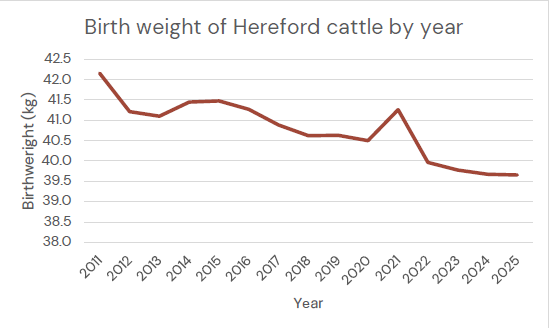
Source: Hereford Cattle Society Breedplan records
Conclusion: The return on an easier calving season
The Return on Investment (ROI) for an easy calving season is found in the things you don’t have to pay for: the vet call at midnight, the replacement heifer for the open cow that didn’t breed back, and the labour hours spent in the physically calving cows.
Management and nutrition are vital, but they cannot overcome a bad blueprint. The easiest way to fix calving difficulty is to start with a bull proven for calving ease. It improves animal welfare, protects your cows’ future fertility, and, perhaps most importantly, lets you sleep through the night.
Is your current sire worth the sleep you’re losing and the fertility you’re sacrificing?
References
Bragg R, Macrae A, Lycett S, Burrough E, Russell G, Corbishley A. Risk factor analysis for beef calves requiring assisted vaginal delivery in Great Britain. Vet Rec. 2021 Jan;188(2):e8. doi: 10.1002/vetr.8. PMID: 34651854.
Gregory, Keith E.; Cundiff, Larry V.; and Koch, Robert M. Characterization of Breeds Representing Diverse Biological Types: Preweaning Traits (1982). Roman L. Hruska U.S. Meat Animal Research Center. 24. https://digitalcommons.unl.edu/hruskareports/24
